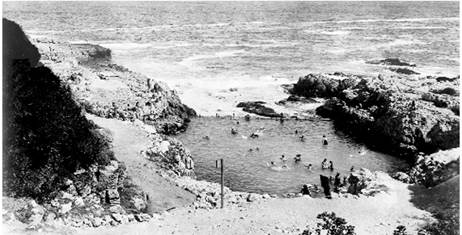
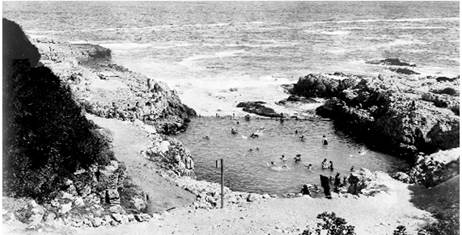
Undated photograph of the well known and loved Fick’s Pool.
1. Background.
A stranger looking at Fick’s Pool today would find it difficult to believe that this pool was once one of Hermanus’ top attractions and social hubs. Older citizens of Hermanus and many regular visitors here in the not-so-distant past remember Fick’s Pool with great and very special fondness. To illustrate this, we referenced local historian S J du Toit’s book “Hermanus Stories III” (2007), p 278, where she quotes as follows from an unpublished memoir by the late Una Graven, grandchild of founding father Christian Warrington.
“When we were approaching our teenage years, Fikkie’s Pool was our summer haunt. The beaches of Voëlklip and New Beach as we called Grotto Beach then, were out of our reach as none of us had any means of transport. Many years later I returned to Hermanus and saw that the name had been changed to Mermaid’s Pool, a concept which is not tailored to my memory at all. Fikkie’s Pool was not a pretty bedtime fantasy – it was where it all happened – splashing in the tidal pool, being frightened when the high tide swept over the retaining wall, clambering over the large rocks and spreading a towel on the warm stone, to lie for hours with the glow of sun on your back. It was giggling and gossiping and taking shy peeks at the opposite sex. It was showing off and innocent flirting with the exciting uncertainties of romance.
It was where the boys challenged each other to what seemed to us then, death defying dives from the opposite cliff just outside the sea wall of the pool. Even I rose to the challenge of swimming across the stretch between the cliffs on the sea-side of the wall after we had been told that a shark had been spotted there. I probably did not believe the story because I was always a total coward and I cannot imagine anything persuading me to swim anywhere remotely near a shark. Well, maybe one thing – perhaps there was a boy I wanted to impress. Fikkie’s Pool was an idyll. Mermaid’s Pool seems too bland a name for such a place of peaceful passion.”
For the information of newcomers who may not know where Fick’s Pool is, this more than a century old tidal pool lies in a secluded cove off Marine Drive on the way to Westcliff. This cove presently hosts the fairly new Fick’s Pool Restaurant and is situated just to the west of the spring Hermanus Pietersfontein, from which the name of the town of Hermanus was derived.
2. But which Mr. Fick was the pool named after?
The answer to this question is not easily ascertained and we need to be guided largely by stories passed down from generation to generation. While little official records exist other than items such as surveyor’s maps, etc., Hermanus is blessed though with an abundance of photographic material, that allows for conclusions to be made in specific cases. Let us look at the clues that we have found.
Dr Robin Lee of the Hermanus History Society (HHS) investigated and published an article on the Society’s website in 2017. He suggested that there are two Fick candidates.
2.1. The first Fick candidate he identified was Mr. J. J. Fick (1875 - 1934), who came here on being appointed as principal when the local “Klipkop” school became a secondary school in1921. He was principal until his retirement in1931 and lived in a house on Marine Drive opposite the pool. As source favouring this candidate Dr Lee quoted S J du Toit’s, Hermanus Stories II, 2002, p226, containing a list of local place names and their meaning or origin, including: “Fick’s Pool – ex headmaster of Hermanus High School, Mr. J J Fick, who lived near the pool in Marine Drive and went to a great deal of trouble to have the pool developed.” He also quoted The Hermanus Times of 11.3.1950, with an article by Ms. Freya Maack who stated: “Under his (Mr. J.J. Fick’s) instigation a swimming pool was built where children could learn to swim”. Neither source states who “gave” the names.
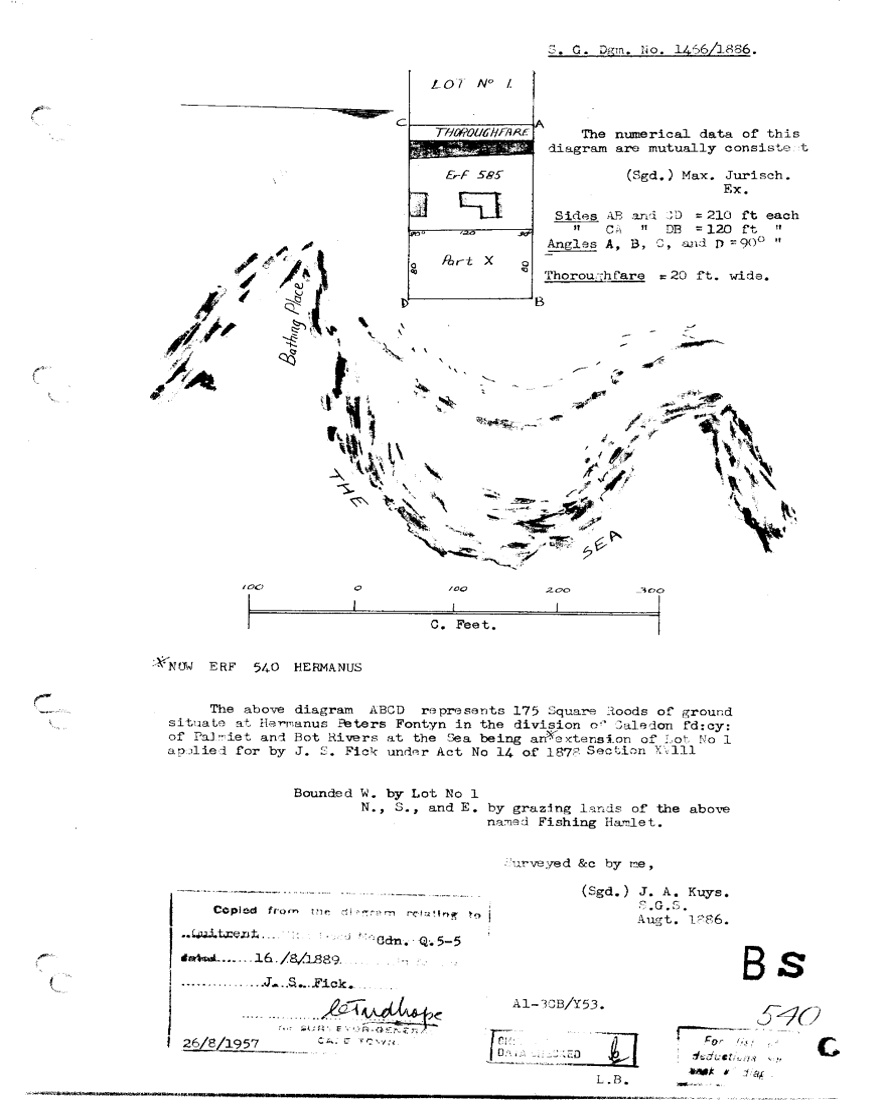
2.2. Dr. Lee’s second possible candidate’s involvement with Hermanus goes back in history quite a bit further. He was Mr. Josias “Sias” Servaas Fick (1830 – 1919), a farmer from the farm Weltevreden in the Caledon district, at one time (1870 – 1885) field cornet for a ward in Caledon. Dr. Lee received information and documents from a member of the same family, Mr. “Lampie” Fick, also originally a farmer from Caledon and former Cabinet Minister. He produced documentary evidence that on the 18 th of August 1889 the said Josias Servaas Fick was granted on a quitrent basis two adjacent erven on the cliff right above the inlet that was described in the surveyor’s plan as a “bathing place”.
Dr. Lee continues that Mr. Fick “… got into the habit of going for a morning swim (at this “bathing place”) each day. He apparently also successfully persuaded others to join him and soon people were referring to (this spot previously called “Die Gat”) as “Fick se Gat”. This was later changed to the socially more acceptable “Fick se Poel” and then anglicized to “Fick’s Pool.”
3. The source of the Pool’s name gets challenged.
In February 2026 the suggestion that the pool was named after the principal, Mr. J. J. Fick, was challenged by the family of the afore-mentioned Mr. Josias Servaas Fick. They have made extensive enquiries and presented us (the Hermanus History Interest Group (HHIG), the successor of the History Society), with a well-argued report complete with photos and surveyor plans to support their claim that the pool was in fact named after Mr. Josias Servaas Fick, their family member. Strange, we now have two candidates by the name
of Fick both living very close to the pool, one on Marine Drive right next to the pool, and the other on an erf also on Marine Drive but right opposite the pool!
This presented a lovely challenge to our committee; what with several members having very close ties from yore with Fick’s Pool. We had several meetings with Mr. Jos Rabie (Fick descendant) and Mr. Lampie Fick and exchanged photos, documents and other evidence. While we soon agreed with the Fick family that their family member was the more likely candidate, we preferred to have more conclusive evidence. We agreed that determining the date when the sea wall, steps and the changing cubicles were built would be very important. Please keep in mind that this story started more than at least 140 years ago!
4. Determining clues regarding the date of development of the Pool.
4.1 Surveyor’s plan of erf on cliff right next to Fick’s Pool.
Please see the copy of Surveyor J. A. Kuys’ Plan dated August 1886 of Erf 585 and Part X on the cliff next to the “Bathing Place” (Annexure A). This illustrates the property that was granted on a quitrent basis to the aforesaid J. S. Fick. Note the hand drawn outline of a house with outbuilding on Erf 585. This drawing appears to coincide exactly with the buildings on the aerial photo below. Drawing in the outlines of existing buildings when an erf was first surveyed was common practice at the time.
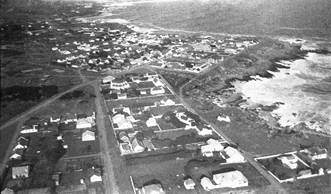
Aerial photo with Mr. J.S. Fick’s house bottom right on the street. C. 1926 - 1929.
4.2 Photo of children bathing in small inlet inside Fick’s Pool.
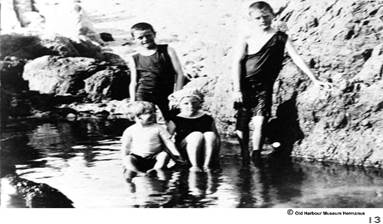
We have positively identified this photo from the OH Museum’s files as having been taken inside the inlet on the eastern side within the perimeter of what is today, Fick’s Pool. Note the swimming garments from very long ago, probably before the sea wall was built (we can deduce from the water level on the photo that the water level is some 300 mm below where it normally would be after the sea wall was constructed. If that deduction is true, this places the date of the construction of the sea wall to well before what has been generally assumed up to now (early 1930’s), thus before 1920!!
4.3 Older photos of Fick’s Pool showing development over time.
Estimating the time of development by looking at details of the infrastructure on various photos in our files.
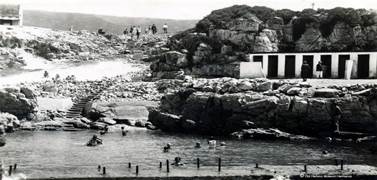
Photo 1. Probably the oldest photo of Fick’s Pool at our disposal. The steps down to the pool have already been built, the sea wall cast, the rocks in the middle blasted apart and removed, and the swimmers are enjoying the facility. The construction of the cubicles appears to be nearing completion, therefore a second, or even a third phase. Painting of the cubicles seems to be in progress. Date? C early 1920’s. See photos 2 and 3. Below.
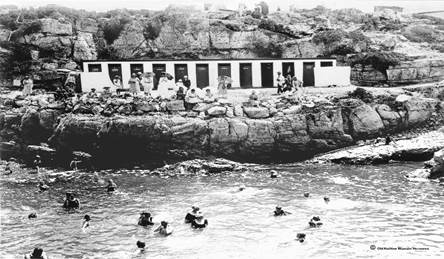
Photo 2. A later version – cubicles are neatly painted. A partition wall in the middle of the cubicles (see photo 1) has been removed, for whatever reason. Would that suggest that this photo was taken after a further phase of construction or maintenance? In that event the original cubicles were built at least a number of years earlier; early 1920’s? Could the sea wall therefore have been built a further number of years earlier; say early 1910’s?
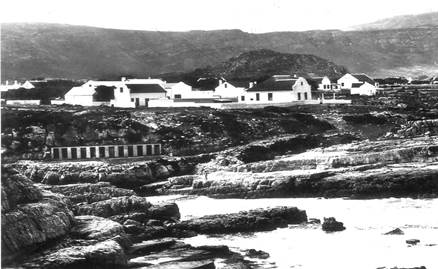
Photo 3. The cubicles appear to be in a neglected state. The privacy walls at both ends as in photos 1. and 2. have been removed. No further facilities are added. Notice the absence of the NGK church building in the background (built in 1926 and dominating the surrounding area in height). The house to the right in the centre foreground facing the sea is that of Mr. Lampie Fick (1877 to 1960) who bought the erf in May 1920 and did not wait long to have his holiday house built. Estimated date of this photo is early 1920’s.
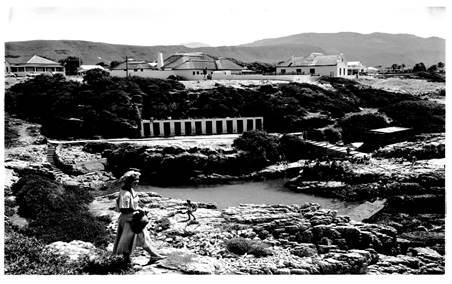
Photo 4. C. 1955. A relatively modern photo. Note the children tanning on the roof of the cubicles. Were you able to see them from close up you would be able to recognise some as being from the HHIGroup! Note also the “pipe” above the sea wall that served the showers in the wooden structure on the right in the rear, a new addition.
5. How were places of interest named in the past?
In our quest to find out who Fick’s Pool was named after it is important to know how the naming process worked when our town started developing.
Interesting enough the answer to this question is fairly simple. At the outset locals almost exclusively “gave names” to natural features, water streams and springs in their village, especially the great number of fishing spots along the long rocky coastline. These names were carried forward by word of mouth, and are an important aspect of our history as carriers of the past. The local authority seldom played a part in the naming process.
For example, the Henn clan in 1857 named their first landing place “Visbaai”. That name stuck for some 80 decades; untill the authorities built the “New Harbour” in the 1940’s and the townsfolk started referring to Visbaai as the “Old Harbour”, again whithout official sanction. The new harbour of course became the “New Harbour”.
Other examples are “Die Neus”, describing a rock that resembles a man’s nose, and “Roman Rock” refers to the many Red Romans caught there. If someone should have done something out of the ordinary at a specific spot, or something happened to him there, that spot would be named after him – eg. the well-known “Piet se Klip” next to the Old Harbour. There are dozens of these names that require to be preserved, including the origins of each! (A new project of the HHIG is to endeavour to determine the origin of each as “oral history”, an important quest (and urgent as those that know are getting fewer!)
Another example of the citizen’s role in the naming process is that of the rocky “koppie” in the centre of the town named simply as “Klipkop”. When Sir William Hoy of railway fame passed away in 1930 his wife reminded oom Danie Woensdrecht, his gielie, about her husband’s wish to be buried at te top of Klipkop. Oom Danie made the necessary arrangements with the municipality and together with Sir William’s other fisherman friends carried his coffin up a newly made footpath for the burial. From that day on the name “Hoy’s Koppie” was used by all, without sanction from any authority. When Lady Hoy died later she was laid to rest next to him.
One of the few examples of the local authority “interfering” is Grotto Beach. Up to the 1940’s Voëlklip Beach was the main beach attraction with established amenites such as changing cubicles, etc. When the municipality started improving the road and amenities at Grotto the locals started flocking there and called it “New Beach”, with the Riviera Hotel referring to the beach as the “Riviera Beach”. The municipality settled the issue by officially calling it “Grotto Beach”, after the beautiful fern-filled semi-caves surrounding the wetland next to the beach, that has since been converted to be an additional parking area.
Another example of the municipality getting involved is, of course the Mermaid’s Pool saga! The name “Fick se Gat” was considered offensive and in1949 the municipality abruptly changed the name to “Mermaid’s Pool”, much to the consternation of everyone. On 5th April 1973 this decision was reversed by the council and the name “Fick’s Pool” was “restored” (? - more about this later).
6. Conclusion drawn from our research – shown in a time-line.
6.1 Mr Josias Servaas Fick (1830 – 1919) had been living or holidaying in a house that he had built some time before 1886.
6.2 This house was right above a natural “bathing place” as identified by surveyor J.A. Kuys in 1886, as per the Plan attached as Annexure “A”. Apart from a rather dangerous spot in front of the now Windsor Hotel there were no other bathing places for residents, and was known to locals as “Die Gat” - as in ‘swemgat’.
6.3 Mr. Josias Servaas Fick “got into the habit of going for a morning swim (at this “bathing place”) each day. He apparently also successfully persuaded others to join him and soon people were referring to (this spot previously called “Die Gat”) as “Fick se Gat”, and the name stuck.
6.4 We believe that the old photo in 4.2 above dates from before 1920, and shows what “Die Gat” looked like, and where in the larger present pool die Gat was located, i.e. in the inlet on the Old Harbour side.
6.5 It stands to reason then that when Mr. J.J. Fick arrived in 1921 to become the High School’s principal, the steps down to the pool and the sea wall had already been built and, the pool deepened, but that the cubicles were in the final phase of construction – see photo 1 in 4.3 above.
6.6 Upon Principal J.J. Fick’s arrival in 1921 the pool had already been known as “Fick se Gat” for close to three decades.
6.7 At least two sources (S.J. du Toit & Ms. Freya Maack – see 2.1 above), mention efforts by principal Fick to persuade the municipality to improve the facilities at the pool. It is uncertain whether these representations regarding the improvement of facilities at the pool led to the construction and maintenance shown in photo 1 and 2 in 4.3 above, or to photo 3 in the same paragraph – to our mind, more likely the latter. Remember, we date photo 3 to “early 1920’s. He arrived only in 1921 and representations to municipalities as we know take time to submit (or get acted upon.)
6.8 In the Caledon Venster of 20th December 1931 it was reported that the Hermanus Municipality had resolved that the “Westcliff Bathing Pool” “…be repaired and painted”. This seems to support the dating in 6.7 above.
6.9 Let us take this point further: the offensive nature of the name “Fick se Gat” prompted the Caledon Venster between 1929 and 1948 to refer to the pool on at least eight occasions as the “the Westcliff Bathing Pool.”
From its inception the Hermanus News (now the “Times of Hermanus”) referred to the Pool as the “Mermaid’s Pool” up to 8th May 1965, when it started using the “old” name “Fick’s Pool” again.
6.10 The name “Fick se Gat” was considered offensive and in1949 the municipality abruptly changed the name to “Mermaid’s Pool”, much to the consternation of everyone. If the pool had been named to honour Principal Fick in view of his efforts to improve the pool, should one wonder why this honour was then taken away?
6.11 On 5th April 1973 this decision was reversed by the council and the name was restored to a more acceptable “Fick’s Pool”.
Conclusion: As a result of our research above, we have no doubt that the pool was was named after Mr. Josias Servaas Fick (1830 – 1919). Our suggestions about the dating of the construction of the steps, sea wall, cubicles and the deepening of the pool is not conclusive, but strongly indicates a considerately earlier period than currently on record.
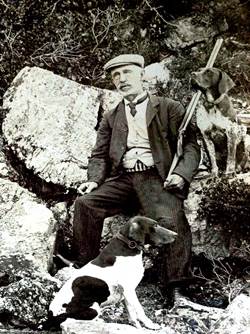
Mr Josias Servaas Fick (1830 to 1919) - Photo supplied by Fick family.
We thank the representatives of the Fick family, Mesrs. Jos Rabie and Lampie Fick, for their extensive research, and for bringing this matter to the attention of the HHIGroup. Also for their assitance and collaboration in bringing this matter to a conclusion. Thanks also to Michael Clark and Dinkie Marais for their assitance and support, as always.
Jack van Dyk obo Hermanus History Interest Group.
8th August 2026.
REFERENCES:
Caledon Venster. Various articles as quoted.
Clark, Nicholas. Land Surveyor, Hermanus. Survey plans and tech. advice.
S.J. du Toit. Four of her well-known books on Hermanus.
Hermanus News, and later, Times of Hermanus. Various articles as quoted.
Lee, Dr Robin. Several books and articles on Hermanus; as quoted.
Paterson, W. H. (Meester): Article on the history of Hermanus at Hermanus’s Centenary, 1955.
Hermanus Old Harbour Museum: Photographic Archive. All photos used, except the one of Mr. Josias S. Fick.
Annexure “A”. Surveyor’s Plan of Mr Josias S Fick’s property above Pool.