A Brief History of the Hemel en Aarde Leper Institute.
The first reported outbreak of leprosy in the Cape Colony occurred in 1756, in the rural district of Stellenbosch. A commission was appointed and its recommendation that lepers should not be allowed to mix with healthy people was approved by the Council of Policy on 17 August that same year. As leprosy spread Khoikhoi and slaves who were afflicted were put under quarantine on a portion of the remote and secluded farm Attaquaskloof (“Attaqua” meaning “men of chief Atta”) in what we presently know as the Hemel en Aarde Valley between Caledon and the sea. They had to build shacks for themselves and the Landdrost of Swellendam in who’s jurisdiction the area fell was required to provide some financial assistance. Space was provided for them to cultivate their own fresh produce. No supervision was provided, although Dr O’Flinn from Stellenbosch was required to visit the lepers fortnightly.
Grazing rights on this farm were granted to colonist Jan Niemand on 9th November 1803, subject to him annually paying rent (“recognition fee”) to the Government. Jan contracted leprosy and in September 1804 his wife, Catharina, who also contracted leprosy, wrote to the Governor requesting that they be released from the obligation to pay the recognition fee as he could no longer provide for his family, and they were in extreme need. Note: When someone contracts leprosy on a remote farm where lepers are quarantined the question that comes to mind is whether there may be a connection. What really happened? We will never know, but it is difficult to believe that there is no connection.
In 1817 Governor Lord Charles Somerset was made aware of the desperate plight of the lepers at their encampment at Attaquaskloof and with the encouragement of Dr James Barry, the young newly appointed Physician to His Excellency’s Household, the Governor issued a proclamation to the effect that the lepers should be allotted “ … a healthy spot, where they may retire to, and where they shall receive such aid as necessary to their future substance and comfort, but to which place the safety of the Public requires they should be confined.” The farm was purchased for this purpose, and a new hospital building and vicarage were completed in 1820. Note: Other sources state that the widow Niemand donated the farm for this purpose. Neither appears to be correct. The farm did not belong to the Niemand’s, occupation being subject to the payment of the “recognition fee”. The Crown could not purchase it either, as it already belonged to the Crown.
Thus, the first leper colony in the Cape Colony was established in 1817. Lepers from all races and classes, soldiers, slaves, Khoikhoi, Christians and Muslims were quarantined in huts and shacks and were given land to grow their own vegetables and fruit. The Reverend Dr Thom of the DRC in Caledon was responsible for the spiritual care of the inmates, and Dr O’Flinn from Stellenbosch, the Surgeon Superintendent of the Institution was required to visit the Institution every two weeks to supervise their medical care.
In 1823 the very young and junior Dr James Barry was promoted by the Governor to the elevated senior position of Colonial Medical Inspector. Passing through Caledon earlier, Dr Barry heard rumors of poor conditions in the Leper Institute and a few months into his tenure Dr Barry requested the Governor to add the inspectorate of the Leper Institute to his duties. He then proceeded to do just that, inspect the Leper Institute. He was accompanied by the Reverend Dr Thom from Caledon. Dr O’Flynn was away on a call. What Dr Barry saw infuriated him and fulfilled the worst rumors he had heard. He reported that the medical treatment of the lepers “is so entirely neglected that as far as I can learn, no attempts to care for the patients have been made”. “The hospital was crowded and dirty, with insufficient bedding, and the lepers were clothed in unclean garments with a rough texture that aggravated the diseased”. He ordered increased rations and measures to improve the lives of the lepers.
When the Governor received Dr Barry’s report he responded by requesting the Moravian Brothers of Genadendal to take over the Institute. “Over the following months James ordered a thorough reorganisation of Hemel en Aarde and issued instructions for the leper’s care, lodging and diet. He made many punishing 150-mile round trips on horseback to check on progress”. The Moravian Brothers from Genadendal appointed the Missionary Peter Leitner and his wife to perform this task of ministering to the leper community to great acclaim of the lepers. The first White person Christened at the Institute was the young daughter of Jan Niemand, by the name of Susan (Sana) Niemand, also a leper.
The Brothers that followed Missionary Leitner were Brothers Tietze (1829), Fritz (1838), and Lehman (1845). Over the years 1823 to1836 the average number of patients at the Institute was 103 per year. It is estimated that the total number of deaths was about 400, most of them buried in a small cemetery not much more than 300 meters down the road towards the sea on the opposite side of the road next to the Antjies River turn off. Of the original buildings only the foundation of the hospital building is visible where a cutting was made for an access road, about 100 meters to the west from the Plaaskombuis entrace.
The Leper Institute was closed in 1845 and the remaining 39 patients moved to Robben Island. In 1931 the Institute on the Island was closed and the patients moved to Westford Hospital outside Pretoria.
At his death in London in 1865 it was discovered that Dr James Barry had been a female.
On 28.9.2026 a plaque commemorating the lepers that died at the Institute was unveiled at the entrance to the Plaaskombuis by Rev G Cunningham of the Genadendal Moravian Church.

A painting of the Hemel en Aarde Leper Institute kept at the Moravian

A pencil sketch of the Institute after the church was built in 1824 (artist unknown).
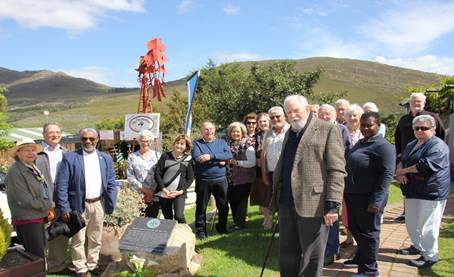
Participants at the unveiling ceremony on the farm Vrede, Hemel en Aarde Valley.
Published by the Hermanus History Interest Group (HHIG) of the U3A Overberg. 28.9.2026.